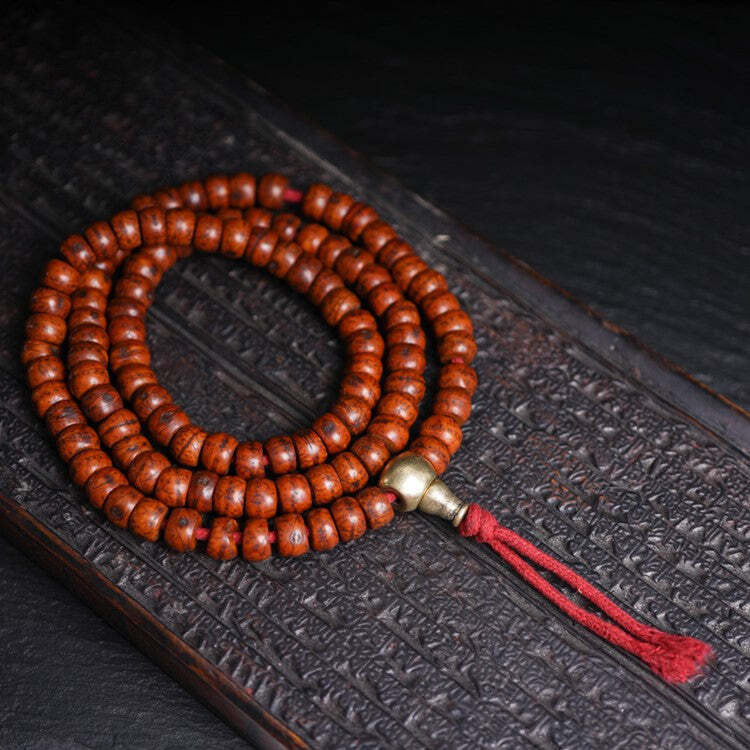
A string of beads looks simple until it enters a life. Then it begins to record things: the warmth of a hand, the oil of the skin, the place where a thumb pauses, the days when practice came easily and the days when it did not.
Why 108?
Across several Buddhist and Hindu traditions, 108 appears as a complete cycle for recitation, reflection and disciplined repetition. Different lineages explain the number in different ways. Those explanations matter, but the practical truth is easier to feel: 108 is long enough for the mind to stop performing and begin settling into rhythm.
You do not need to rush through the full strand. A practice can begin with nine beads, twenty-seven beads or one deliberate circuit around the wrist. The number gives the practice structure; it does not judge the person practicing.
How a mala becomes yours
New beads may feel perfect, separate and slightly unfamiliar. Use changes that. Knots soften. Seeds deepen in color. Wood takes on a quiet polish. The strand begins to move according to your hand rather than the maker's table.
This is why honest wear should not be confused with damage. Patina can be the visible record of care. At the same time, wear alone cannot prove a dramatic history, a particular owner or a specific blessing. Those are separate claims and should have separate evidence.
A practice for ordinary days
- Choose one intention. Not a list of outcomes. One quality you want to remember: patience, courage, restraint, compassion or clarity.
- Begin at the marker. Hold the first bead without trying to manufacture a special feeling.
- Pair touch with breath or phrase. One bead, one breath. Or one bead, one short line you can say honestly.
- Stop without failure. If your attention leaves, notice it. Returning is the practice.
Choosing the right strand
Choose first by use. A large seed may offer stronger tactile feedback; a smaller bead may sit more easily at the wrist. Dense wood has a different rhythm from porous seed. Stone brings weight and coolness. Thread tension determines whether a strand feels fluid or architectural.
Then ask about facts: material, bead count, diameter, condition, repair history and known source. Finally, ask whether the object makes you want to return to it. A mala that remains untouched is only a beautiful arrangement of beads. A mala used with attention becomes a companion.